
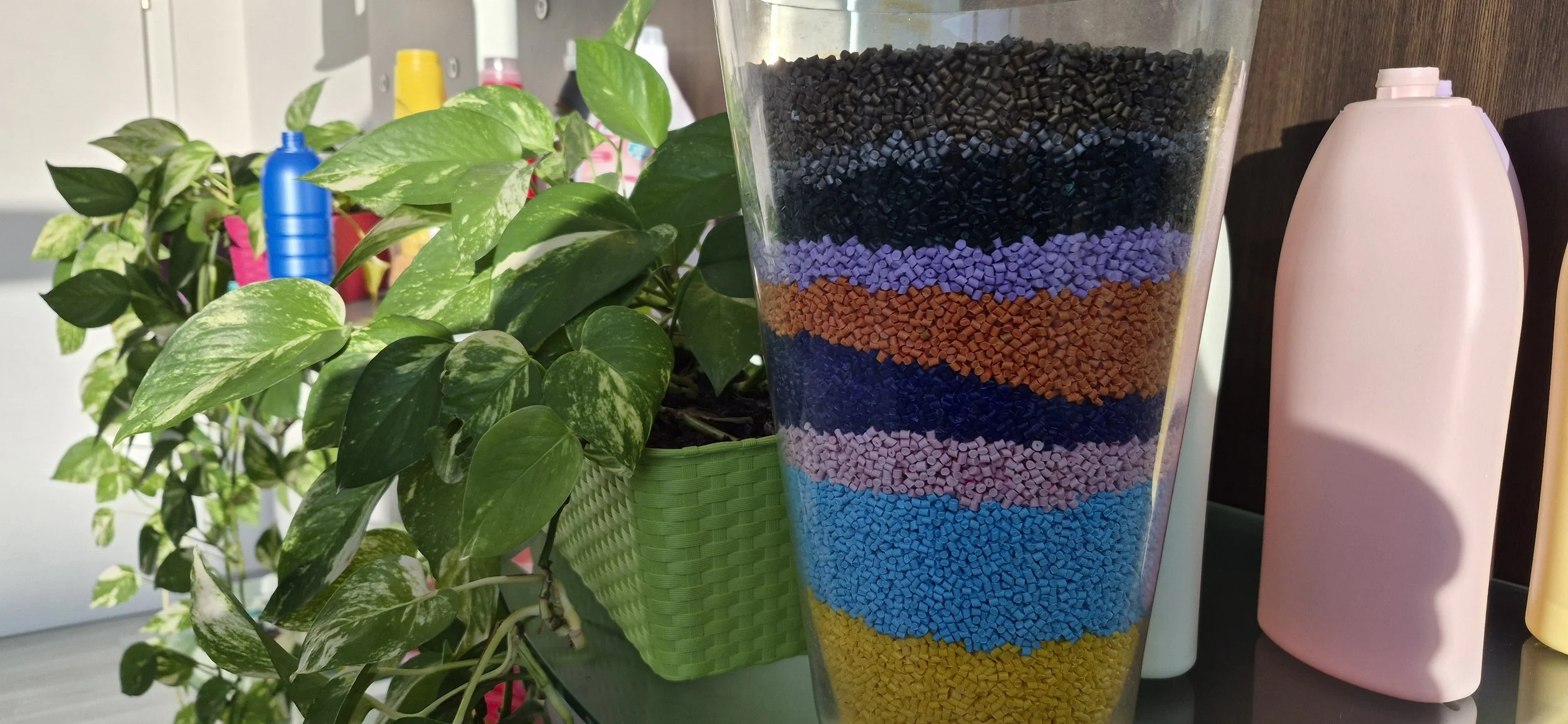
In the plastics processing industry, masterbatch is often perceived as a purely functional component used for coloring or adding properties to the material. In reality, its role is far more strategic and has a direct impact on quality, production efficiency, and the reliability of the final product.
A properly designed masterbatch enables homogeneous pigment dispersion, long-term color stability, and optimal compatibility with the base polymer. These factors are essential to reduce waste, machine downtime, and variability between production batches.
At KolorPlast, masterbatch development always starts from an analysis of the customer’s production process. Parameters such as processing temperature, extrusion or molding speed, type of polymer, and final application are considered from the earliest formulation stages. This approach makes it possible to design solutions that do not merely “work,” but integrate seamlessly into the industrial cycle.
Applied research plays a central role: dispersion tests, stability checks, and quality controls accompany every stage of the process. The result is a masterbatch that contributes not only to the aesthetics of the product, but also to its repeatability, durability, and long-term reliability.
In an increasingly competitive market, masterbatch thus becomes a true strategic lever, capable of improving overall production performance and creating tangible value for the companies that use it.