
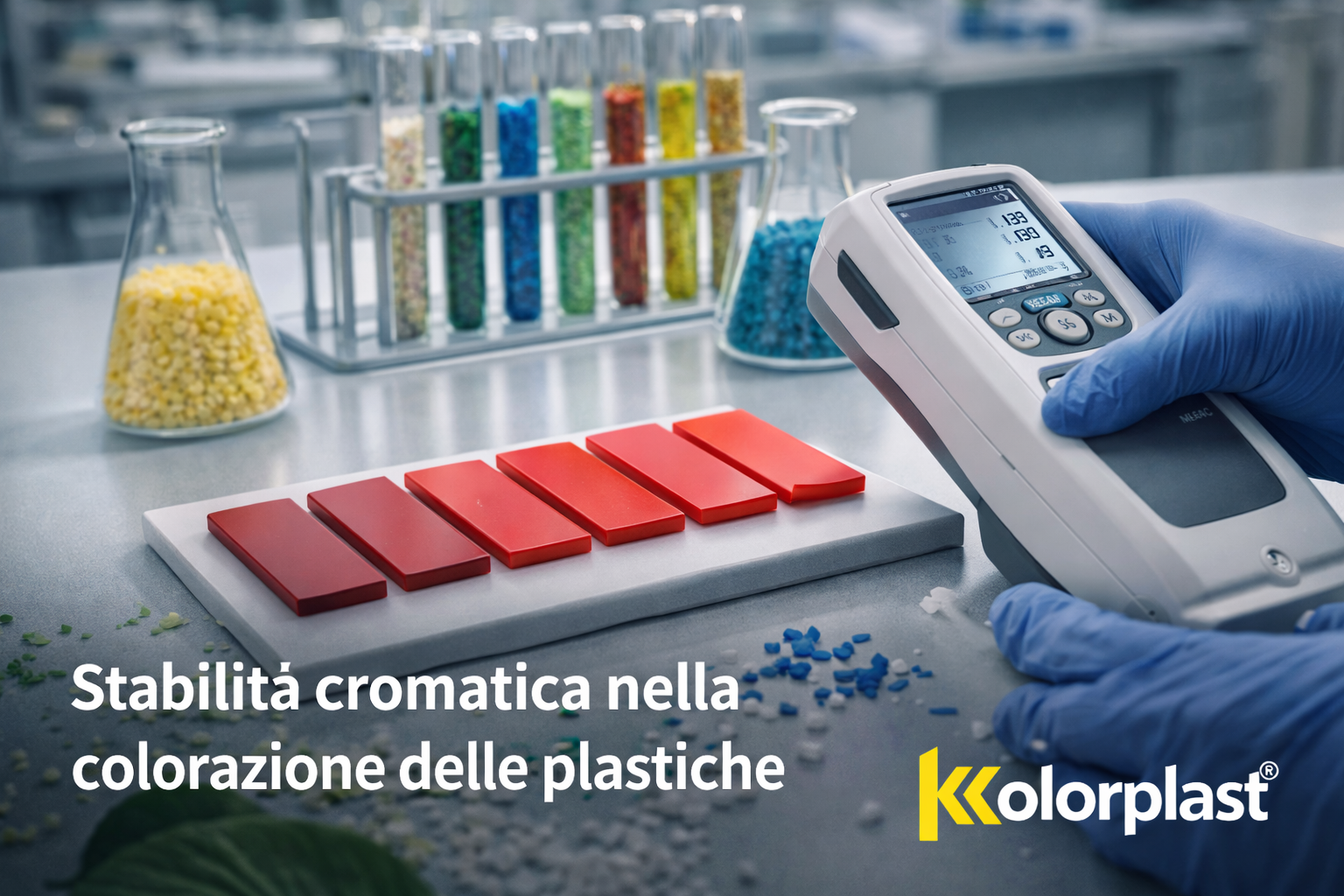
Color Stability in Plastics: A Strategic Factor in Industrial Quality
In the plastics transformation industry, color is not merely an aesthetic element. It is a technical parameter that influences product perception, batch-to-batch consistency, and a manufacturer’s credibility in the market.
Achieving the correct shade is only the first step. The real challenge lies in ensuring long-term color stability throughout processing and across the entire lifecycle of the finished product.
What is color stability?
Color stability refers to the ability of a colored plastic material to maintain its shade without significant variations caused by:
high processing temperatures
exposure to light and UV radiation
mechanical stress
chemical or environmental agents
differences between production batches
Even minimal color variation can compromise product uniformity, generate claims, or require reprocessing, leading to higher costs.
Factors influencing color stability
Color stability depends on a combination of technical elements:
1. Pigment selection
Not all pigments respond in the same way to high temperatures or light exposure. Selection must consider both the polymer type and the transformation process.
2. Compatibility with the polymer
A masterbatch that is not fully compatible may lead to uneven dispersion or inconsistent behavior during extrusion or molding.
3. Dispersion control
Non-homogeneous dispersion directly affects color yield and repeatability.
4. Processing parameters
Temperature, residence time, and operating conditions all influence final color stability.
The KolorPlast approach
At KolorPlast, color stability is addressed already at the masterbatch design stage. The Research & Development department carries out targeted application tests, thermal resistance evaluations, and instrumental quality checks to ensure uniformity and repeatability.
The goal is not only to achieve the correct color, but to guarantee industrial consistency: the same result today, tomorrow, and across subsequent batches.
Through a rigorous methodology and a laboratory equipped with advanced analytical instruments, KolorPlast develops solutions designed for sectors where precision and quality are essential.
Why it is a strategic topic
In an increasingly competitive market, color stability represents a tangible advantage.
It reduces risk, limits waste, improves product reliability, and strengthens a company’s market image.
In the world of plastics, color is not a detail.
It is a technical indicator of process robustness.
And process robustness is what truly makes the difference.